 Skip to content
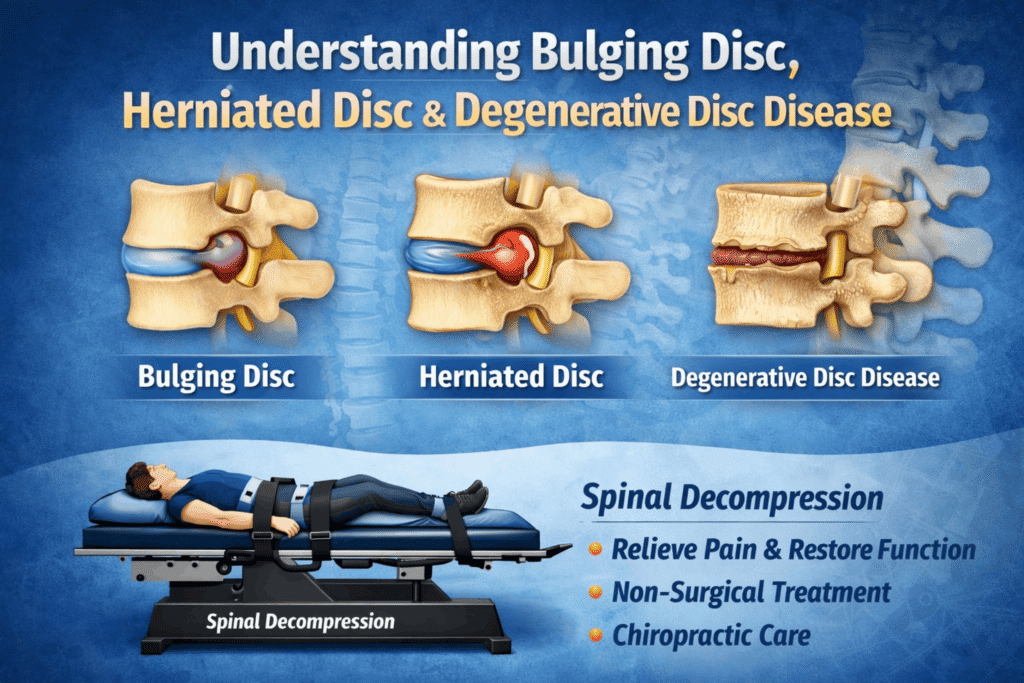
Back pain is one of the most common reasons people seek chiropractic care in Altamonte Springs and surrounding areas. If you’ve ever been told you have a herniated disc, bulging disc, or degenerative disc disease, you might be wondering what that actually means—and more importantly, what you can do about it.
While these conditions are related, they are not the same. Understanding the differences can help you make informed decisions about your care and recovery.
What Are Spinal Discs?
Your spine is made up of bones (vertebrae) separated by soft, cushion-like structures called intervertebral discs. These discs act as shock absorbers and allow your spine to move smoothly.
Each disc has:
- A tough outer layer (annulus fibrosus)
- A soft, gel-like center (nucleus pulposus)
When these discs are damaged or begin to wear down, pain and other symptoms can develop.
What Is a Bulging Disc?
A bulging disc occurs when the disc protrudes outward beyond its normal boundary, but the outer layer remains intact.
Key Points:
- The disc bulges evenly around its circumference
- Often caused by aging, poor posture, or repetitive strain
- May not cause pain unless it presses on a nerve
Think of it like a hamburger that’s too big for the bun—it spills out slightly but doesn’t break open.
What Is a Herniated Disc?
A herniated disc (also called a slipped or ruptured disc) is more severe. It happens when the outer layer tears, allowing the inner gel to leak out.
Key Points:
- The disc ruptures or cracks
- The inner material can irritate nearby nerves
- Often causes sharp pain, numbness, tingling, or weakness
This is more like the hamburger actually breaking through the bun.
What Is Degenerative Disc Disease?
Despite the name, degenerative disc disease (DDD) is not really a disease—it’s a condition that happens as your discs naturally wear down over time.
Key Points:
- Discs lose hydration and elasticity
- Common with aging, but can be accelerated by injury or lifestyle
- May lead to chronic back or neck pain
- Can contribute to bulging or herniated discs
DDD is a long-term process, while bulging and herniated discs are more structural changes that can happen along the way.
Key Differences at a Glance
| Condition | What Happens | Severity | Symptoms |
|---|---|---|---|
| Bulging Disc | Disc protrudes outward | Mild–Moderate | Often none or mild pain |
| Herniated Disc | Disc ruptures and leaks | Moderate–Severe | Pain, numbness, tingling |
| Degenerative Disc Disease | Disc wears down over time | Varies | Chronic stiffness, pain |
How Chiropractic Care Can Help
At Vargas Family Chiropractic, we focus on non-invasive, drug-free solutions to help relieve pain and restore function.
Chiropractic Adjustments
Gentle spinal adjustments can help:
- Improve alignment
- Reduce nerve pressure
- Restore mobility
Spinal Decompression Therapy
We also offer spinal decompression therapy using a specialized decompression table, which is especially effective for disc-related conditions.
This therapy works by:
- Gently stretching the spine
- Creating negative pressure within the disc
- Helping reposition bulging or herniated material
- Promoting nutrient-rich blood flow for healing
Many patients in Altamonte Springs choose decompression therapy as a safe alternative to surgery.
When Should You Seek Care?
You should consider seeing a chiropractor if you experience:
- Persistent back or neck pain
- Pain that radiates into the arms or legs (sciatica)
- Numbness or tingling
- Reduced flexibility or movement
Early treatment can help prevent the condition from worsening.
Why Choose Vargas Family Chiropractic?
If you’re in Altamonte Springs, Orlando, or surrounding areas, our office is equipped to help you get real results.
We provide:
- Personalized treatment plans
- Advanced spinal decompression therapy
- A patient-focused, results-driven approach
Our goal is not just temporary relief—but long-term healing and improved quality of life.
FAQ: Herniated vs Bulging Disc vs Degenerative Disc Disease
1. Which is worse: a bulging disc or a herniated disc?
A herniated disc is typically more severe because the disc has ruptured and can irritate nearby nerves, often causing more intense symptoms.
2. Can a bulging disc turn into a herniated disc?
Yes. If the outer layer of the disc weakens further, a bulging disc can progress into a herniated disc.
3. Is degenerative disc disease reversible?
While the degeneration itself cannot be reversed, symptoms can be effectively managed with chiropractic care, decompression therapy, and lifestyle changes.
4. Does spinal decompression really work?
Yes, many patients experience significant relief. Spinal decompression can reduce pressure on discs and nerves, helping the body heal naturally.
5. Do I need surgery for a herniated disc?
Not always. Many cases improve with conservative treatments like chiropractic care and decompression therapy, avoiding the need for surgery.
6. How long does it take to feel better?
This depends on the severity of your condition, but many patients begin to notice improvement within a few visits or weeks of care.
Ready to Get Relief?
If you’re struggling with back or neck pain from a herniated disc, bulging disc, or degenerative disc disease, we’re here to help.
Contact Vargas Family Chiropractic today to schedule your consultation and find out if spinal decompression therapy is right for you.
📍 Vargas Family Chiropractic
931 N State Rd 434, Suite 1195
Altamonte Springs, FL 32714
📞 Call or Text: 321-972-4567
